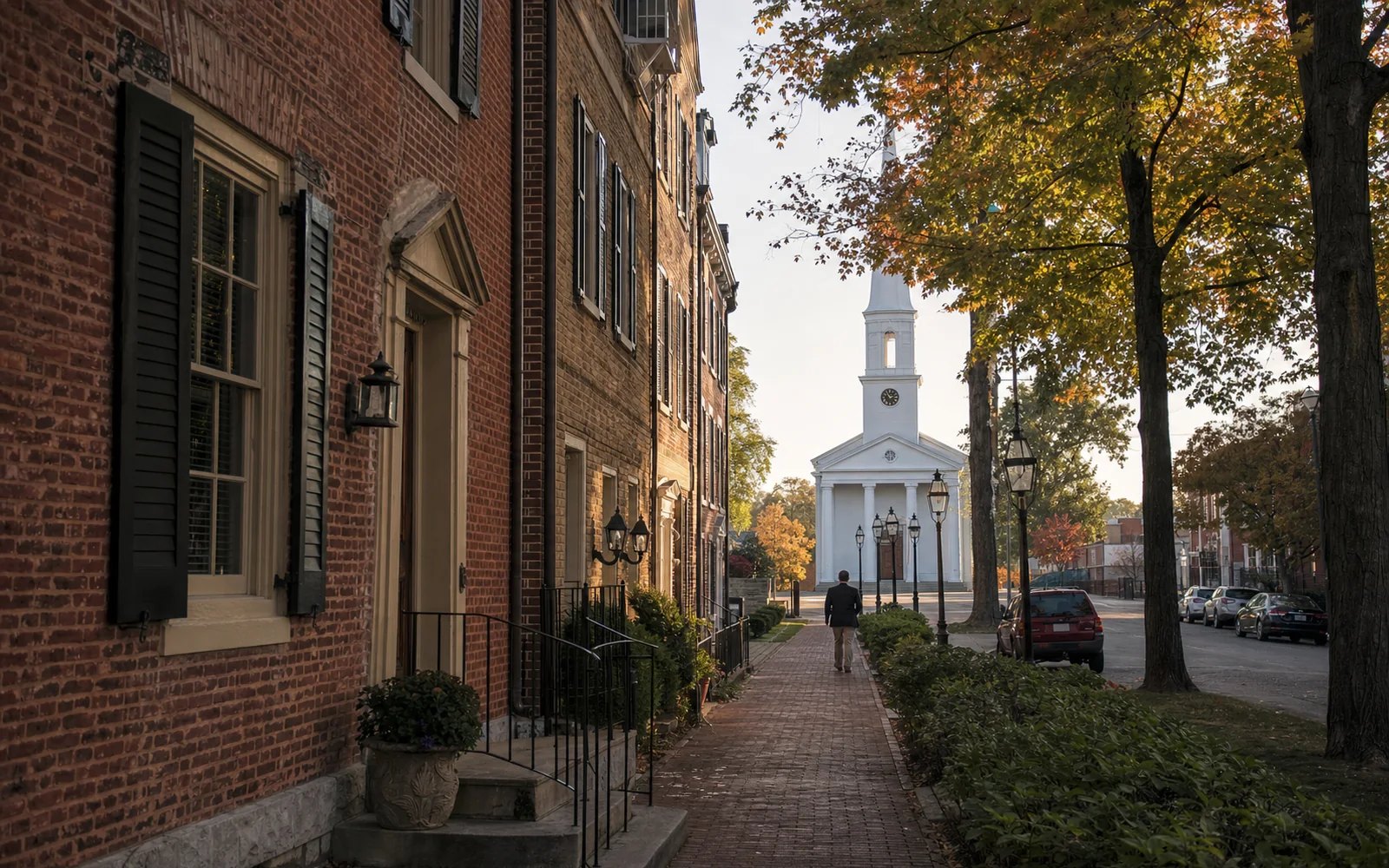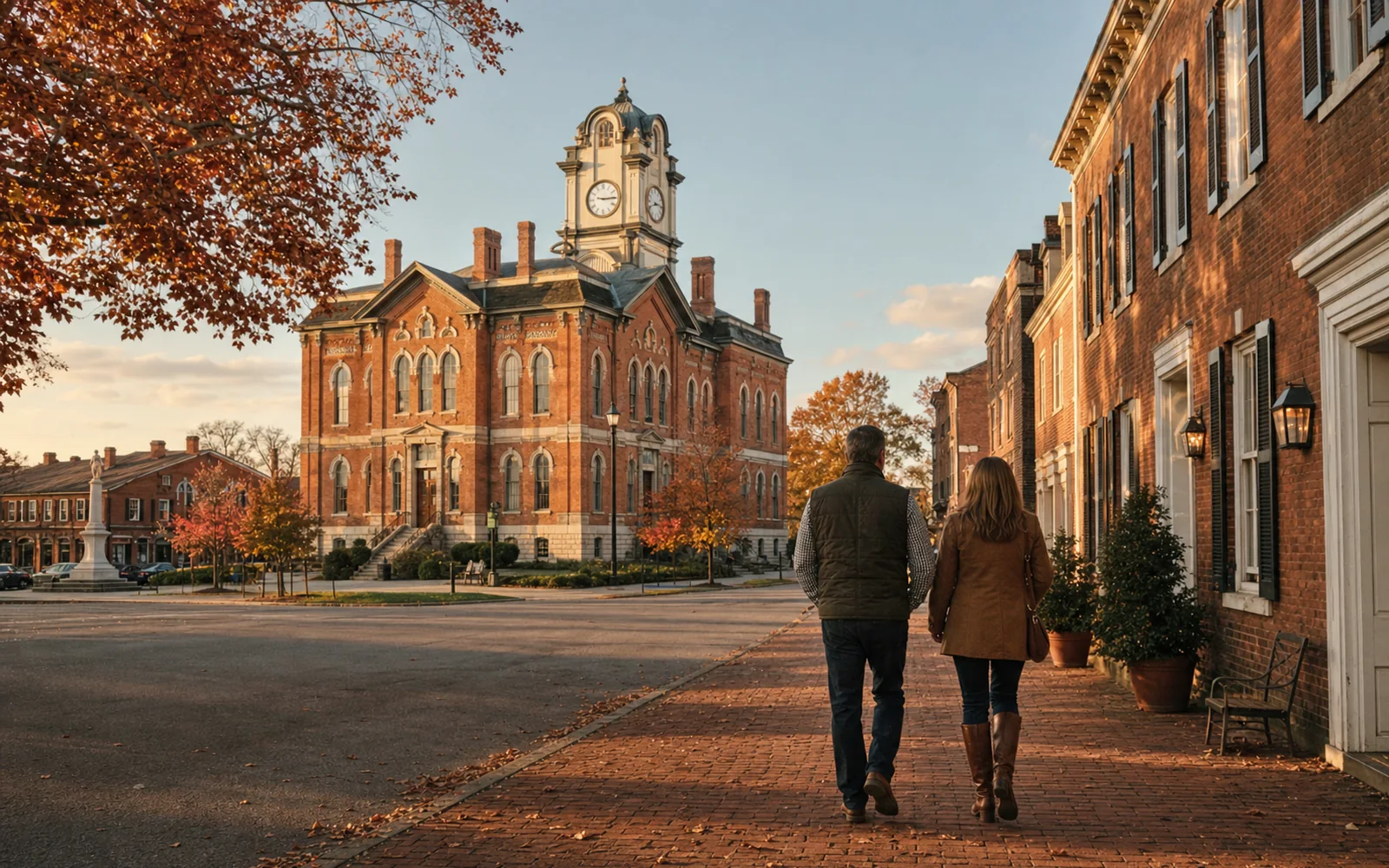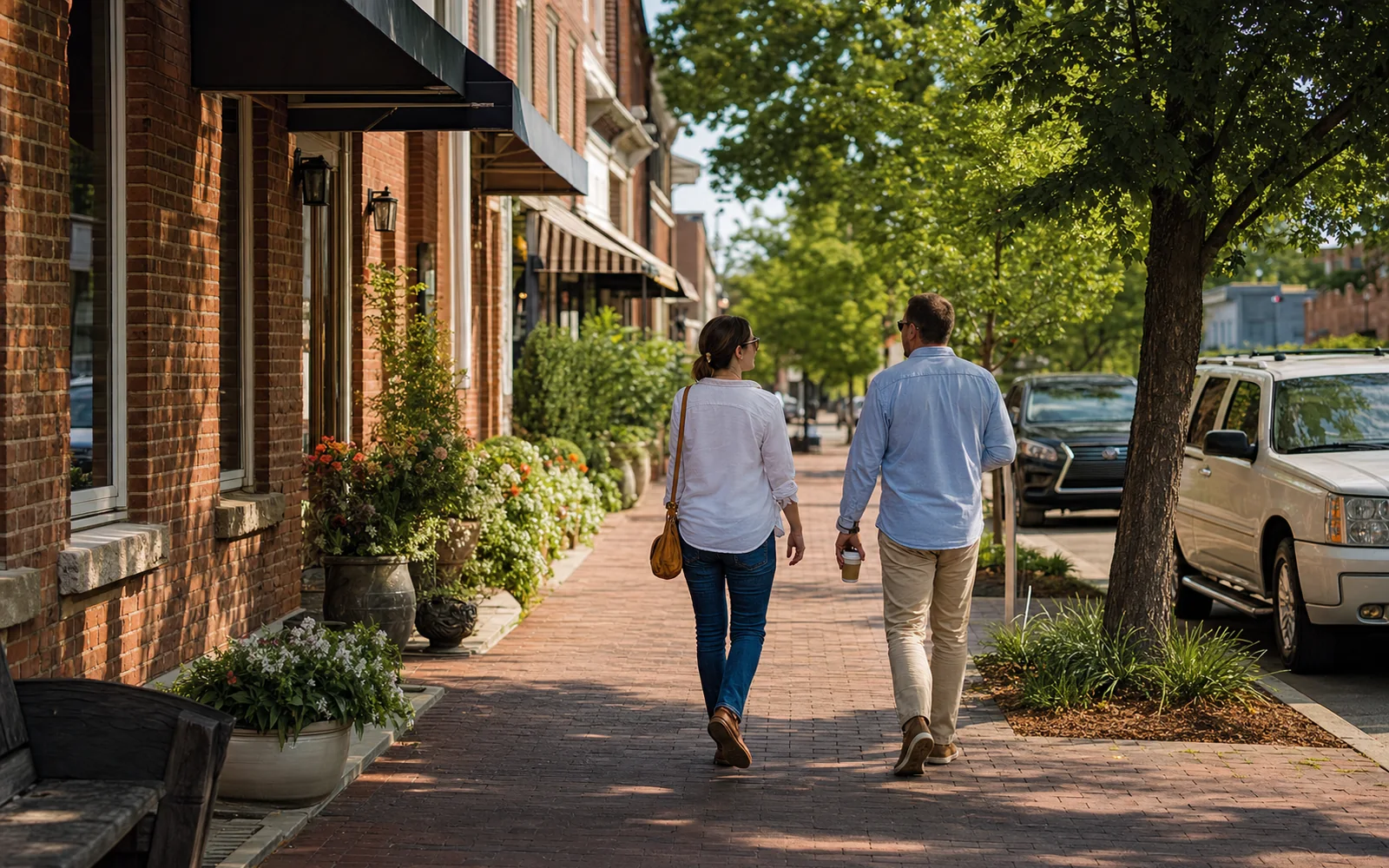
Downtown Bardstown is a working textbook of early American building. The Bardstown Historic District, on the National Register since 1983, covers 26 blocks and 279 properties, and more than a third of its buildings are Federal or Georgian, dating from the 1780s to 1850. You do not need a degree to enjoy it: learn five or six details (brick bonds, fanlights, stone lintels, roof shapes) and the whole square starts telling you who built what, and roughly when.
Why so much survived
Bardstown boomed early and then, by frontier standards, slowed down. It was a rich court town and a church capital in the first half of the 1800s, and its leading families built in brick and limestone. When the diocese moved to Louisville in 1841 and the big money followed the rivers and railroads, nobody needed to tear down the old buildings to make room for bigger ones. Later generations recognized what they had: travel writers now single out the Federal and Georgian fronts and the cobblestone paths, which is part of why Visit Bardstown can claim nearly 200 historic buildings in a walkable downtown.
Five things to look for on any old building
Brick bond
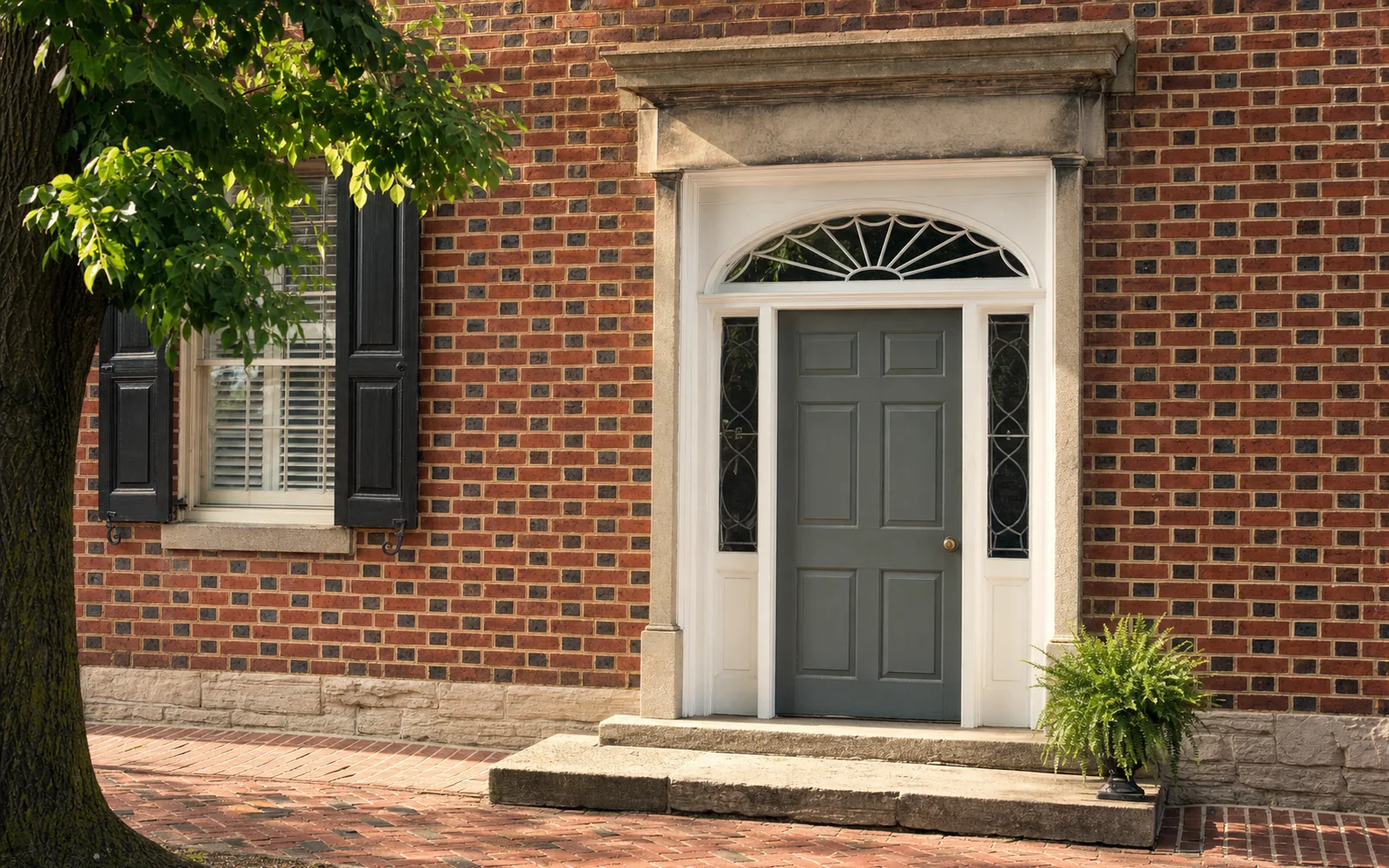
Look at how the bricks are laid. In Flemish bond, each row alternates the long side (stretcher) and the short end (header), often with darker, glazed headers that make a subtle checkerboard. It was the prestige pattern of the Federal era. Federal Hill’s brick was fired on site and laid in Flemish bond, according to the park’s history. Plainer common bond, with a row of headers every five to seven rows, usually signals a later or more modest building.
Symmetry
Georgian and Federal fronts are balanced: a center door with the same number of windows on each side, three or five bays across. When you find a five-bay front with a centered door, you are almost certainly looking at something from before 1850.
Doorways
Federal builders loved the semicircular or elliptical fanlight over the door, sometimes with slim sidelights. Georgian doors tend to be heavier, with a flat transom and a pediment. Greek Revival, which arrives in the 1820s and 1830s, swaps the curves for a rectangular transom and square pilasters.
Windows
Early windows have many small panes (six-over-six or nine-over-nine), with flat stone or brick lintels above. Tall two-over-two sash usually means the Victorian era, when larger panes of glass became affordable.
Stone
Nelson County sits on limestone, and the builders used it. The old jail’s front building has limestone walls 30 inches thick, and the tavern’s original section has stone walls two feet thick. Rough, rubble-laid stone generally reads older than neatly cut ashlar blocks.
Buildings to find on a walk
| Building | Date | What to notice |
|---|---|---|
| Old Talbott Tavern | 1779 (stone section) | Thick stone walls of the east end, brick west wing added later |
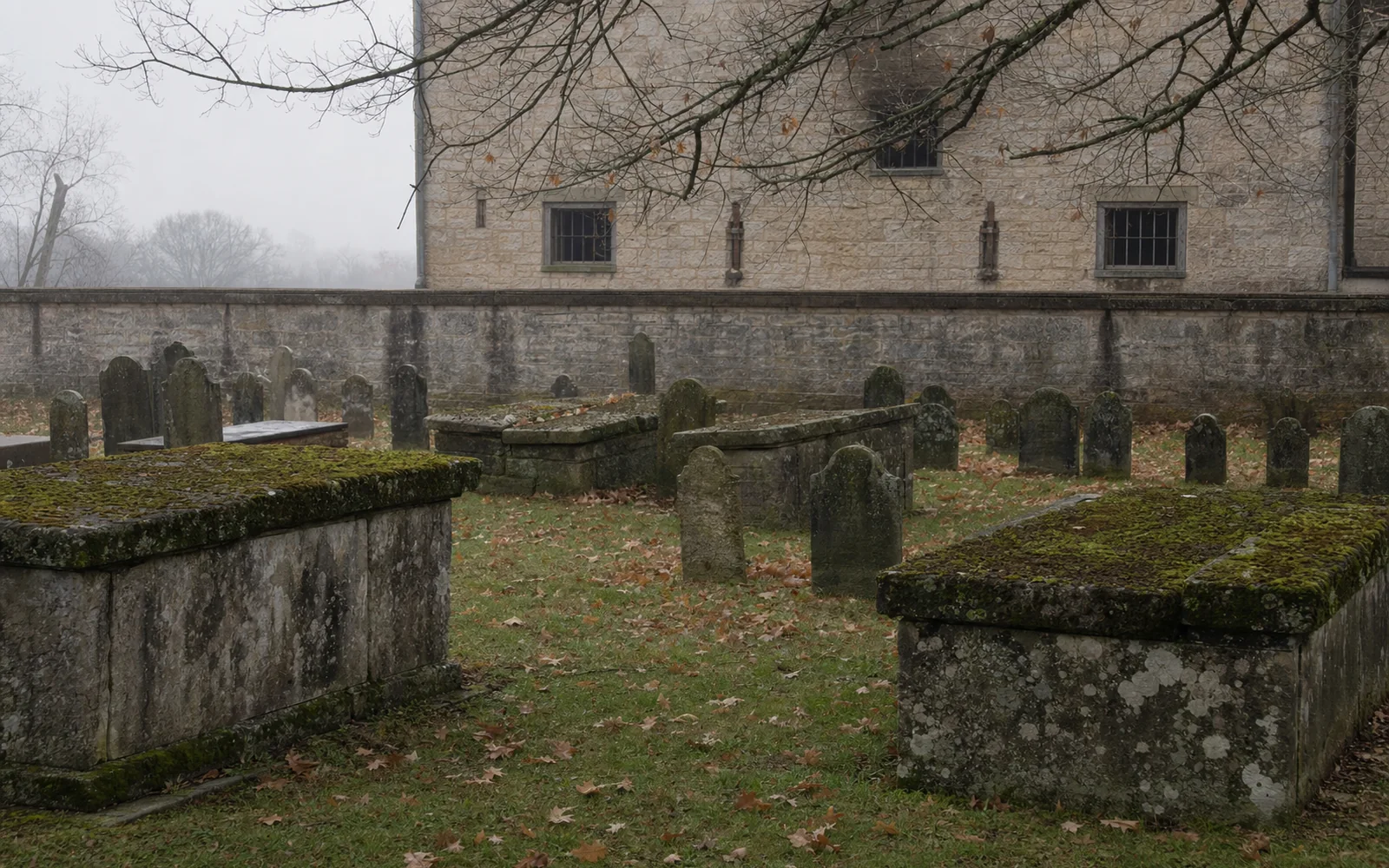
| Old Nelson County Jail (Jailer’s Inn) | 1819 front, 1874 back | Limestone front building; dry-stone back jail behind a tall wall |
| Basilica of St. Joseph | 1816 to 1823 | Greek Revival columned portico and tall steeple, architect John Rogers of Baltimore |
| Spalding Hall | 1826, rebuilt 1839 | Long Federal-style college building on a green lawn |
| Union Church | 1812 | Two-story brick church, now the African American Heritage Museum |
| Nelson County Courthouse | 1892 | Brick courthouse in the middle of Court Square, now the visitor center |
| Federal Hill | 1795 and 1818 | Three-story, five-bay Federal mansion in Flemish bond, a mile east |
| Wickland | 1813 to 1817 | Georgian mansion with a cantilevered staircase, east on US 62 |
Court Square
Start at the center. The 1892 courthouse stands in the middle of it all and houses the visitor center. Stand on its steps and look west down Stephen Foster Avenue: the Old Talbott Tavern and the old jail at Jailer’s Inn sit nearly side by side, more than two centuries of public life in one block. The John Fitch monument on the square, which includes a replica of his first steamboat, marks the grave of the steamboat pioneer, who died in Bardstown in 1798 and was moved here from the Pioneer Cemetery in 1927.
West toward the cathedral
Walk a few blocks west to the Basilica of St. Joseph Proto-Cathedral. Its portico of columns and tall spire look more like a New England meetinghouse than a European cathedral, and that is the point: this was frontier Catholicism, built by a Baltimore architect with local materials. Turn onto North Fifth Street for Spalding Hall, the old college building that now holds the Getz Museum.
The East End
North Second Street, in the Historic East End, holds Union Church, described by its museum as the first two-story brick church west of the Appalachians. It is quieter than the square and full of smaller brick and frame houses. Our African American Heritage Museum page covers hours.
The mansions outside the core
Two great houses stand just beyond the downtown grid. Federal Hill is the textbook Federal house: 13-foot ceilings, ash floors and carved mantels by a free Black craftsman. Wickland is Georgian, with a staircase that seems to float, since it has no visible support.
The later layers: Victorian fronts, a depot and a cobblestone path
Not everything worth seeing is from the founding era. The National Register nomination counts several later buildings as contributing to the district, including the old L&N railroad station, the 1892 courthouse and the Cobblestone Path, per the district’s Wikipedia entry. Along the main commercial streets you will also spot later storefronts with larger display windows and more decorative rooflines than their plain Federal neighbors, a sign of the town’s life as a county market and railroad stop in the late 1800s and after.
Read these as layers rather than intrusions. A Federal house with a Victorian porch tacked on, or a Georgian storefront with a later plate-glass ground floor, tells you the building stayed useful. The town’s recent history adds one more layer: old commercial buildings reused as tasting rooms, galleries and restaurants, which is how most visitors end up inside them.
How to see it well
Walk early or late. Low morning and evening light rakes across brick and shows off the texture of the bonds and the carved stone; midday sun flattens everything. Fall is the prettiest season, with maples turning against red brick, and the Arts, Crafts and Antiques Fair fills the streets on the second weekend of October. Winter has its own appeal when the square is lit for Christmas.
Wear flat shoes: some sidewalks are old brick and the cobblestone paths are uneven. Most district houses are private homes, so admire from the sidewalk and keep off porches.
Getting there and parking
Court Square is the center of town, where US 31E, US 62 and US 150 meet. Park once in a public lot or on-street downtown and walk everything in this guide except Federal Hill and Wickland, each a few minutes’ drive east. The getting around and parking guide has the details.
Pair it with
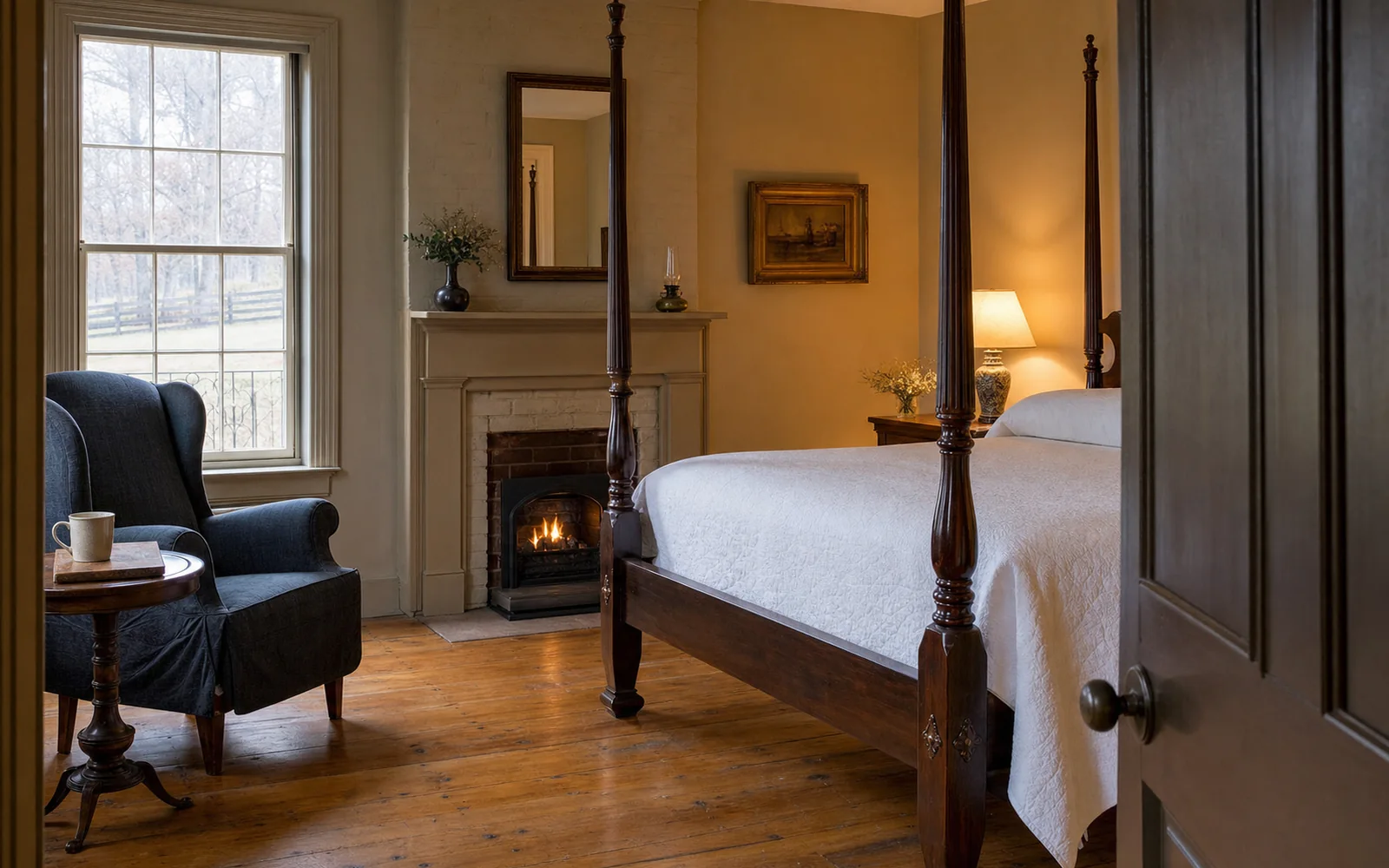
Follow the route in our self-guided walking tour, then eat lunch in the oldest building on the list at the Old Talbott Tavern restaurant. To sleep inside the district’s architecture, browse historic inns and B&Bs.