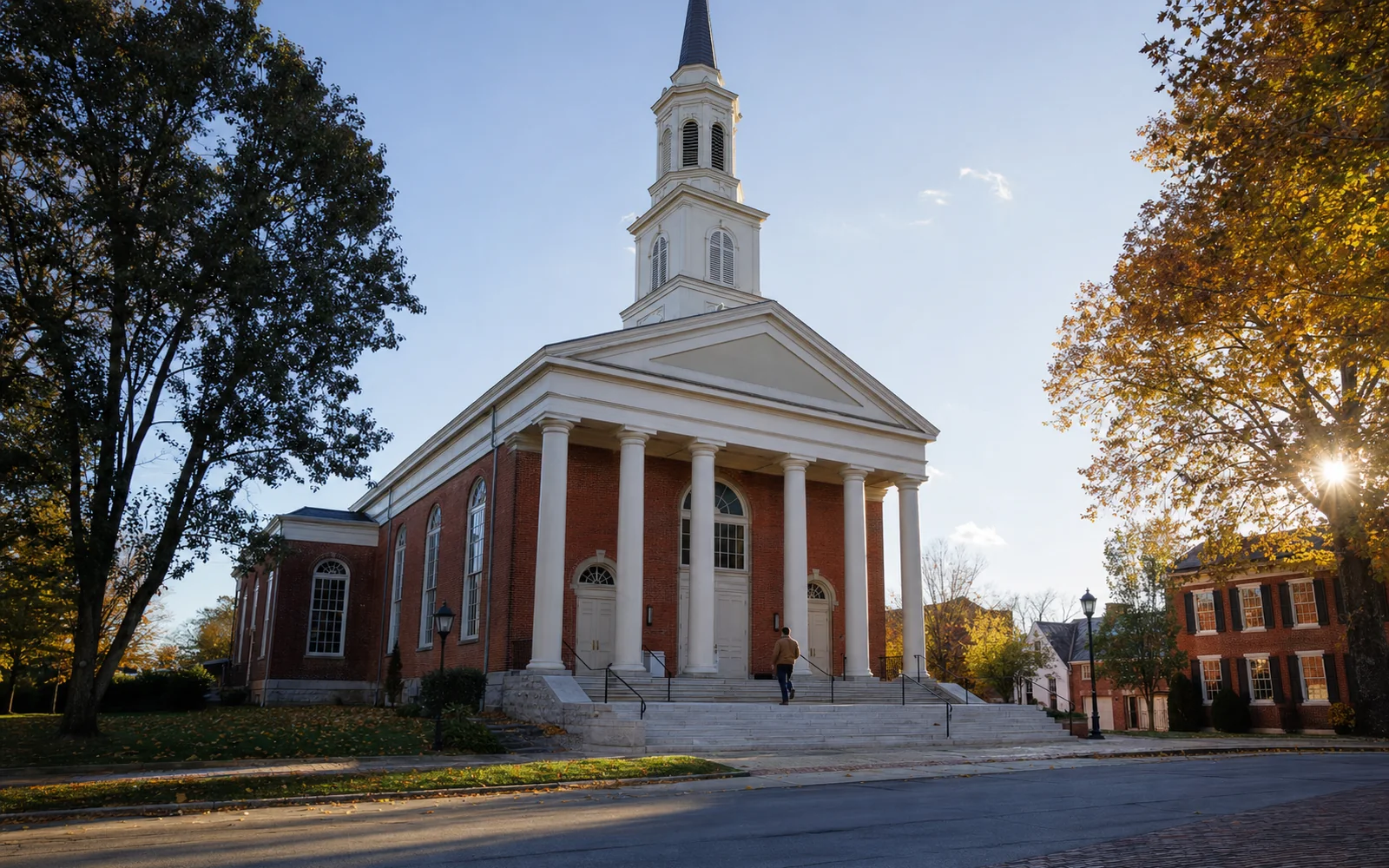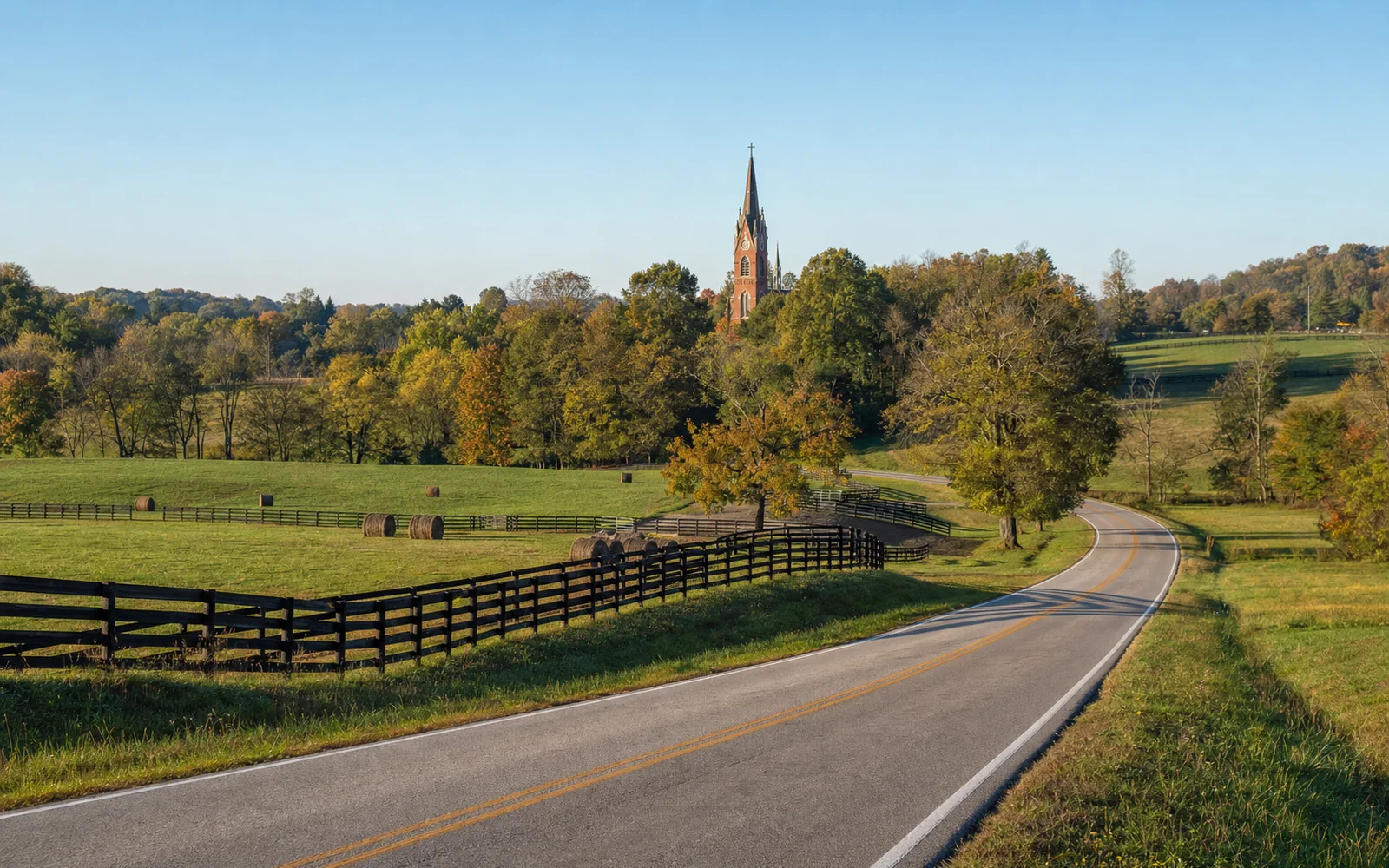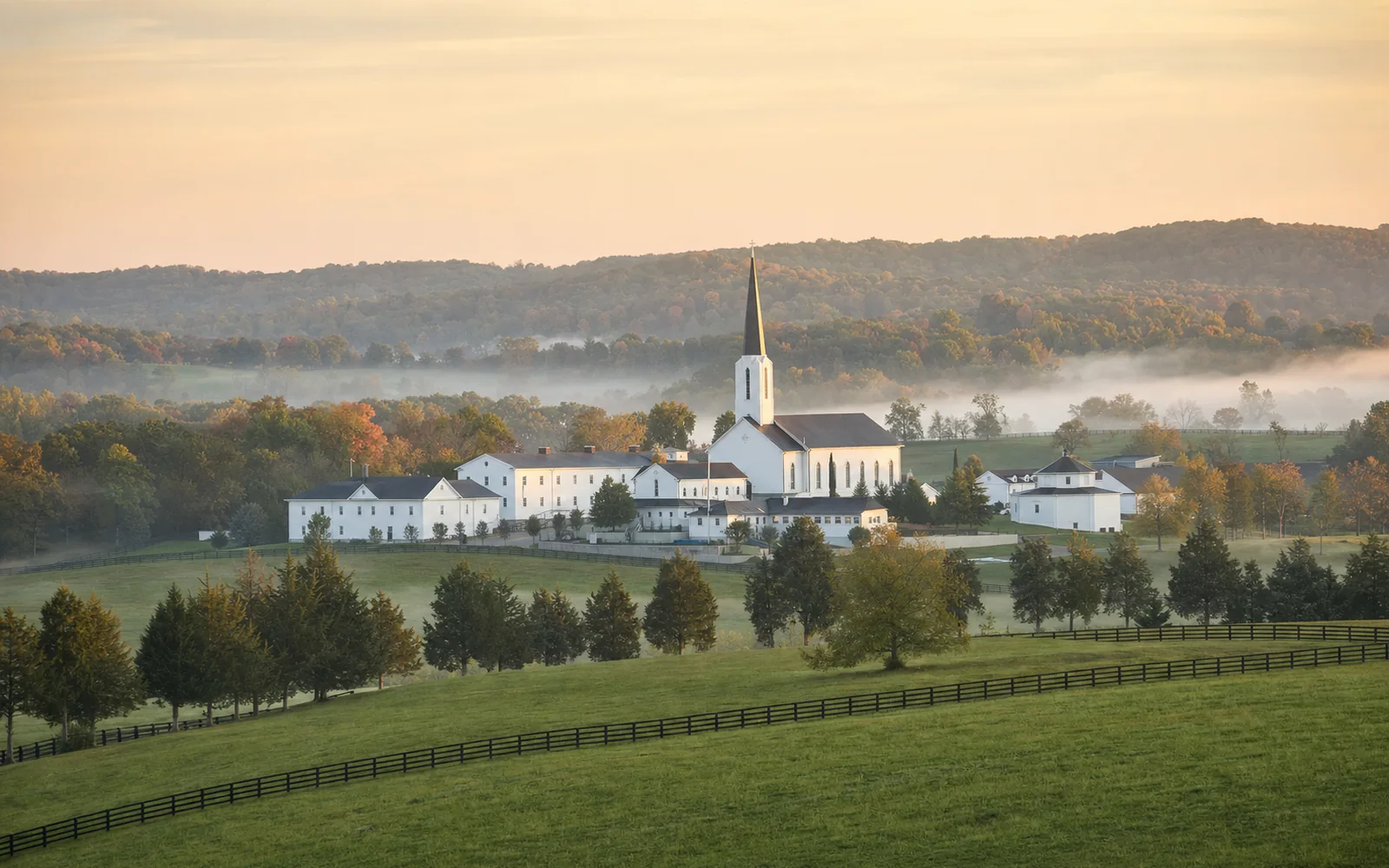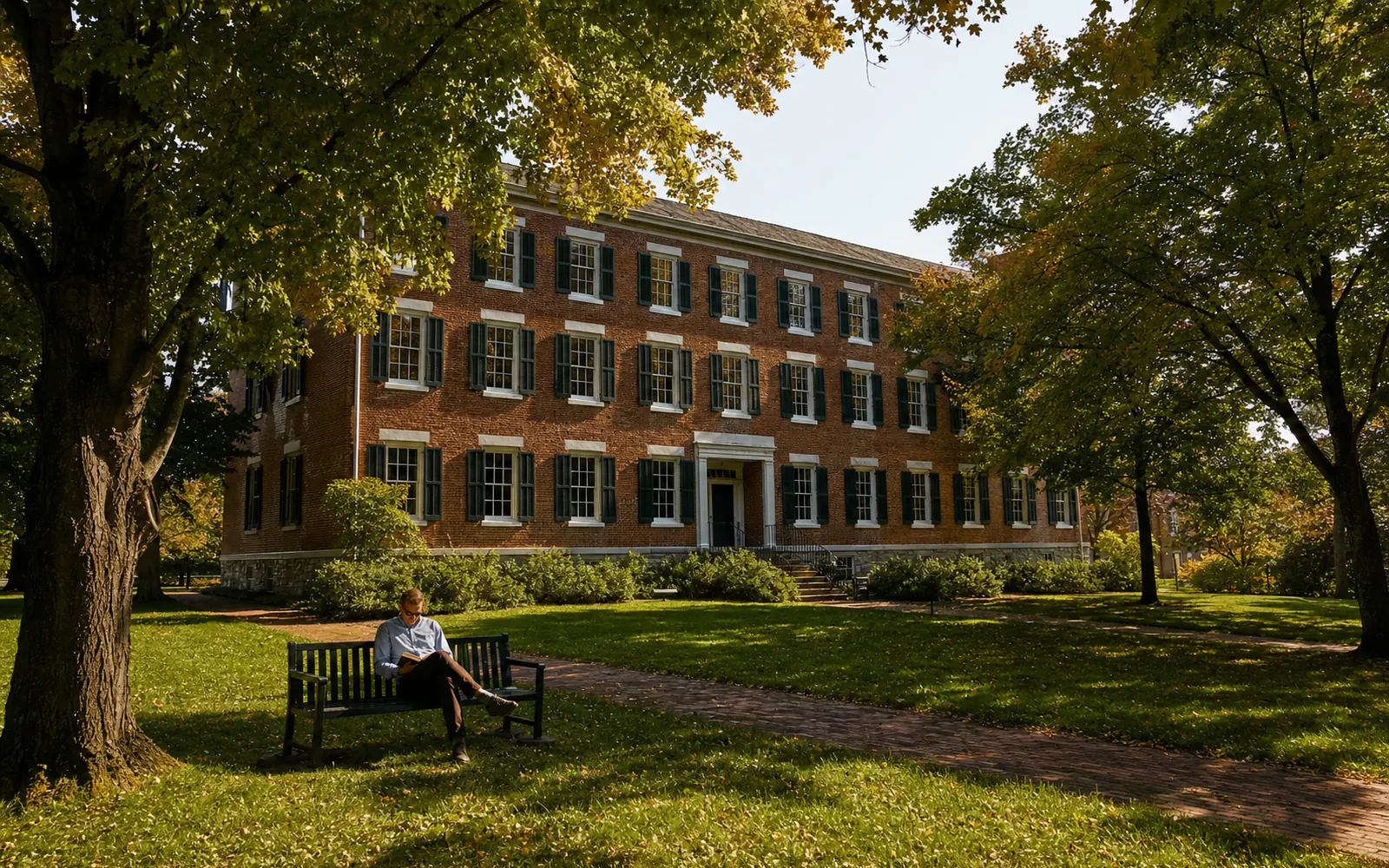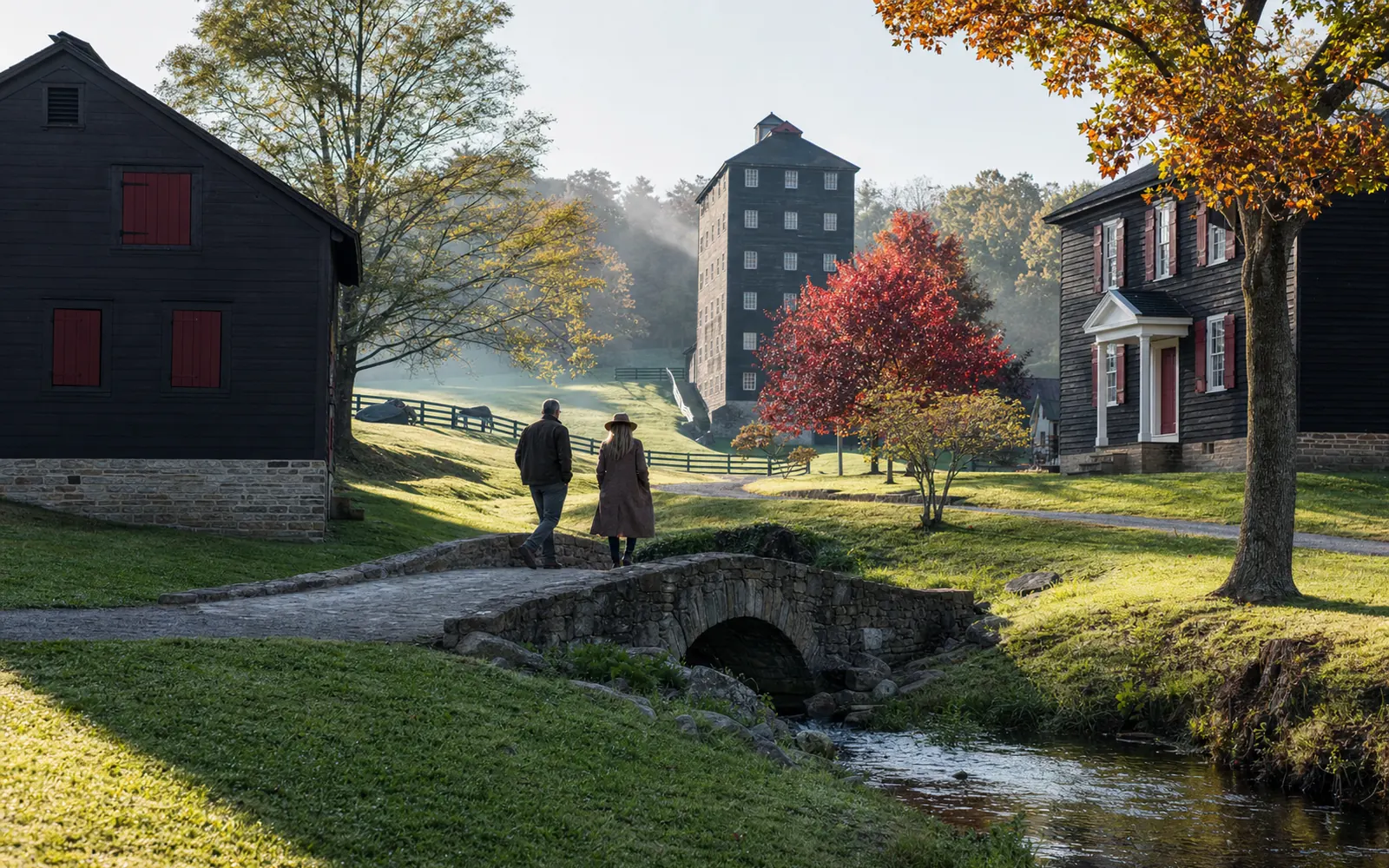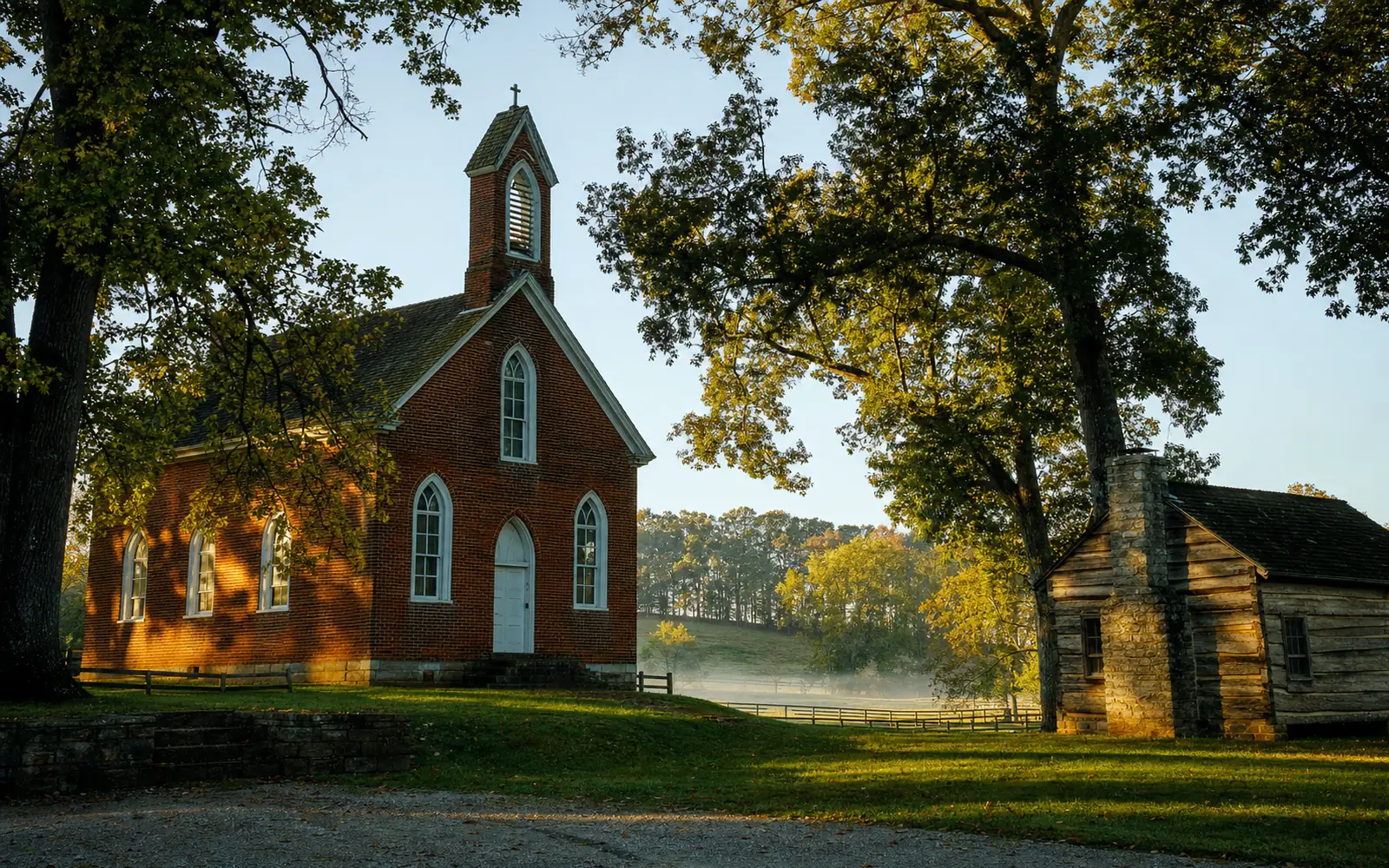
St. Thomas Church is a small 1816 brick church about 3 miles south of Court Square, and next to it stands the 1795 log house where the first Catholic seminary on the American frontier began in 1811. It is free, quiet and rarely busy, and it takes about 45 minutes including the drive. Go if the Basilica of St. Joseph downtown made you curious about how a Kentucky farm town ended up as the Catholic capital of the early West, because this is where that story actually starts.
What you’ll see at St. Thomas
Two buildings carry the visit, and they are about as different as buildings can be.
The church is Neo-Gothic brick, designed by Maximilian Godefroy after St. Mary’s Seminary Chapel in Baltimore and dedicated on August 15, 1816. That Baltimore connection is the key to the whole place. Most of the Catholic families who settled this part of Nelson County came over the mountains from Maryland, and they built what they remembered. Look for the pointed windows, which were a fashionable, almost daring choice for a country church in 1816, when most Kentucky churches were plain boxes or log meetinghouses.
The Howard-Flaget House is the older and humbler of the two: a log house built in 1795 by Thomas and Ann Howard on their 109 acres. Stand in front of it and do the arithmetic. When the seminary opened here, Kentucky had been a state for less than twenty years, and this cabin held both the classroom and the chapel until the church and other buildings were finished.
The grounds are the third part of the visit. The parish sits on a rise in open farmland, and on a clear fall morning the light across the brick is the best reason to come early.
The story: from a Maryland family’s farm to a frontier seminary
The timeline is short, and it rewards knowing before you arrive.
In 1787 Edward Howard led a group of Maryland Catholics to settle near Bardstown. The Howard land became a public place of worship in 1806, to take pressure off crowded churches elsewhere. Thomas Howard willed the land to the church in 1810.
Meanwhile Rome had created the Diocese of Bardstown in 1808 to cover every Catholic between the Appalachians and the Mississippi, an area that later became ten states. Its first bishop, the French Sulpician Benedict Joseph Flaget, was consecrated in 1810 and reached Kentucky in 1811. A bishop needs priests, and priests need a seminary, so St. Thomas Seminary was formally established on May 22, 1811, on the Howard farm. The National Register history of the site calls it “the first Roman Catholic seminary on the American frontier.”
It ran as a major seminary until 1819, when the new cathedral in Bardstown was ready to take over that role, and then as a minor seminary until 1869. One of its students, from September 1826, was Martin John Spalding, whose name you will see again on Spalding Hall downtown.
Where the Sisters of Charity of Nazareth began
St. Thomas has a second founding story, and for many visitors it is the more moving one. The Sisters of Charity of Nazareth were founded here in 1812 under Bishop John Baptist Mary David. Catherine Spalding joined in January 1813 and was elected superior at 19. She led the community for 45 years.
The sisters stayed at St. Thomas until 1822, then moved a few miles north of Bardstown to Nazareth, where their motherhouse still stands. They went on to open Nazareth Academy, Presentation Academy in Louisville and the college that became Spalding University, and they nursed in Civil War hospitals. Their own history is honest about the hard parts too: in 2000 the community formally apologized for its past slaveholding, a reminder that the frontier church was built partly on enslaved labor. The page on Black history in Bardstown picks up that thread.
If the St. Thomas chapter hooks you, the Nazareth visitor center and Heritage Hall museum are open Tuesday through Saturday from 9 a.m. to 4 p.m., about 3 miles north of Court Square. Pairing the two in one morning shows you the community’s first home and its permanent one.
Later chapters: orphanage, school and parish
After the seminary years, the parish kept adapting. An orphanage operated on the grounds from 1850 to 1889, then moved into Bardstown. An elementary school ran here from 1914 to 1931 and again from 1957 to 1998, so there are plenty of Nelson County adults who went to grade school in the shadow of this church. The church and the log house were listed together on the National Register of Historic Places on July 12, 1976.
Today St. Thomas is an active parish of the Archdiocese of Louisville. That shapes how you visit, which is the next section.
How to visit St. Thomas respectfully
This is a working country parish, not a staffed museum. There is no ticket desk, no published visitor schedule and no gift shop.
- Go outside Mass times. Weekends bring parishioners; weekday late mornings are usually quiet. If you want to see the interior, attending weekend Mass is the most reliable way, and visitors are welcome to sit in the back.
- Expect locked doors on some days. The exteriors and the log house are the heart of the visit, so a locked church is not a wasted trip.
- Keep your voice low on the grounds, park only where it is obviously allowed, and keep drones at home.
- Dress for a church. Nothing formal, but cover up a bit if you plan to step inside.
For the photographers: the brick faces the morning light well, and October gives you gold trees behind the church. Late afternoon puts the log house in soft side light.
How to get there from Court Square
St. Thomas is about 3 miles south-southwest of downtown, roughly a 10-minute drive on country roads. Head out of town toward the south and follow Saint Thomas Lane; set your map app to “870 Saint Thomas Lane, Bardstown.” Cell service is fine this close to town, but download the route if you are continuing deeper into the county.
There is no public transit or trolley. If you have been tasting at the distilleries, get a driver or come on a morning before the bourbon starts. The getting around and parking page covers local ride options.
Pair it with
St. Thomas works best as the first stop of a Catholic-history morning, not as a standalone outing.
| Pairing | Why it fits | Drive from St. Thomas |
|---|---|---|
| Basilica of St. Joseph Proto-Cathedral, downtown | The cathedral the seminary’s priests served, finished 1819 | About 10 minutes |
| Nazareth motherhouse and Heritage Hall | Where the sisters moved in 1822 | About 15 minutes |
| Abbey of Gethsemani | Trappist monastery founded 1848, Thomas Merton’s home | About 20 to 25 minutes |
| Loretto Motherhouse and Maker’s Mark | The other 1812 women’s community, next to a famous distillery | About 30 minutes |
For the full circuit, read Kentucky’s Holy Land, then add the Abbey of Gethsemani for the afternoon. If you would rather mix faith and bourbon, a Loretto and Lebanon day combines the Sisters of Loretto with Maker’s Mark.
Back in town, lunch on Court Square is easy. The Old Talbott Tavern is a fitting choice, since Bishop Flaget’s Bardstown and the tavern’s stagecoach days overlap almost exactly.
Is St. Thomas worth the drive?
For history lovers, yes, without much debate. You get the rare chance to stand beside the actual log building where a whole regional church began, with no crowds, no fee and a country setting that has not been paved over. Families with restless kids and visitors on a tight bourbon schedule can skip it and still get the story at the Basilica downtown. Everyone else: give it the first hour of a morning, while the light is low and the lane is empty.